
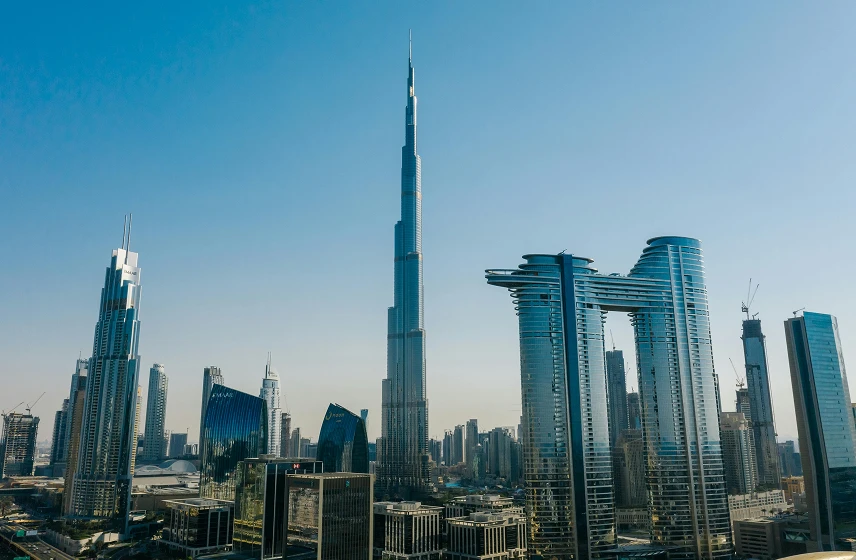
When coordinated US-Israeli strikes on Iran in late February 2026 killed Supreme Leader Ali Khamenei and triggered Iranian retaliation across the Gulf, the consequences for the UAE were immediate and tangible. Drone debris struck near the Burj Al Arab. Abu Dhabi's airport was disrupted. The Dubai Financial Market closed. For a country that has built one of the world's most remarkable real estate markets on the proposition of stability and openness, this was not a distant war, it was a test that arrived at the front door. Here is a definitive account of how the conflict is reshaping UAE and global property markets.
The UAE: Direct Impact, Measured Response
No property market in the world has been more directly affected by this conflict than the UAE's. Drone and missile strikes targeted infrastructure in both Dubai and Abu Dhabi. The Dubai Financial Market benchmark dropped 4.65% at open on March 4, with Emaar and major developers leading the sell-off. The DFM Real Estate Index fell approximately 21% from its pre-conflict peak. Yet remarkably, the physical property market has continued to function: 36,831 transactions were recorded between January 1 and March 8, 2026, up 7% year-on-year. The UAE government's response was measured and strategic: the National Emergency Crisis and Disasters Management Authority declared the situation 'under control,' while Abu Dhabi doubled down on diplomacy. (The Middle East Insider / MapHomes Real Estate, March 2026)
Transaction resilience: Dubai recorded AED 11.93 billion in property sales in the single week of March 2-9, 2026, in the middle of active conflict. The market paused; it did not stop. (APIL Properties, March 2026)
The Structural Stress Test: What Has Been Revealed
The conflict has exposed structural vulnerabilities in the UAE market that were present before the war but masked by momentum. UAE corporate bonds are the worst performers in emerging markets in March 2026, according to Bloomberg. Six real estate developer bonds are trading at distressed levels. JPMorgan's warning about oversupply, 300,000-400,000 new units by 2028 that the market may not be able to absorb, is now more pressing. And the safe haven narrative, while not destroyed, has been complicated for the first time in modern UAE history. (Bloomberg March 2026; Outlook Luxe, March 2026)
Abu Dhabi vs Dubai: A Tale of Two Markets
The conflict has sharpened the distinction between Dubai and Abu Dhabi as investment destinations. Dubai, with its higher dependence on international capital, tourism, and speculative buying, faces more near-term risk. Abu Dhabi, with a tighter supply pipeline, stronger government backing, and residential prices that rose approximately 32% year-on-year into late 2025 (CBRE), offers more pricing insulation. Abu Dhabi's ADIA sovereign wealth fund, with assets estimated above $900 billion, represents an ultimate financial backstop that provides a structural floor under the market.
Global Ripple Effects: Who Benefits, Who Suffers
Beyond the UAE, the conflict is having measurable effects on global real estate. In the UK, new buyer enquiries fell sharply as mortgage rate expectations rose due to oil-driven inflation concerns. In India, a 14% surge in Tier-2 and Tier-3 city real estate markets has been linked to the return of skilled workers from the Gulf region. Singapore and other politically neutral wealth hubs have seen increased inbound interest from investors diversifying away from Middle East exposure. Switzerland and London have seen renewed interest from wealthy UAE-based families seeking portfolio diversification. The conflict is, in a sense, redistributing real estate capital globally.
The Long View: UAE Property's Enduring Proposition
Despite the most serious geopolitical test the UAE has faced in modern times, the country's fundamental property market proposition has not been erased. Zero income tax. Dirham-dollar peg. Golden Visa. World-class infrastructure. A government that has consistently demonstrated willingness to support the market through challenging periods. Abu Dhabi's sovereign backstop. And a global demand base from over 150 nationalities that, even when some withdraw temporarily, is continuously replenished by new waves of investors and residents seeking what the UAE uniquely offers.
The Bottom Line for UAE Property Decisions in 2026
The Iran-Israel conflict is reshaping UAE real estate, but reshaping is not destroying. The market has entered a more complex, more analytical, and more negotiation-driven phase. Buyers who move with information, strategy, and a genuine long-term horizon are operating in conditions that will likely look like an attractive entry point in retrospect. Investors who panic or dismiss the risks entirely will both make costly mistakes. As Sherwoods Property (March 2026) summarised from 38 years of UAE market experience: 'Every single time, the investors who moved during the uncertainty came out significantly ahead of those who waited for the headlines to clear.'
Sources: The Middle East Insider (March 2026), MapHomes Real Estate (March 2026), APIL Properties (March 2026), Bloomberg (March 2026), Outlook Luxe / JPMorgan (March 2026), CBRE UAE (2025-2026), Sherwoods Property (March 2026).